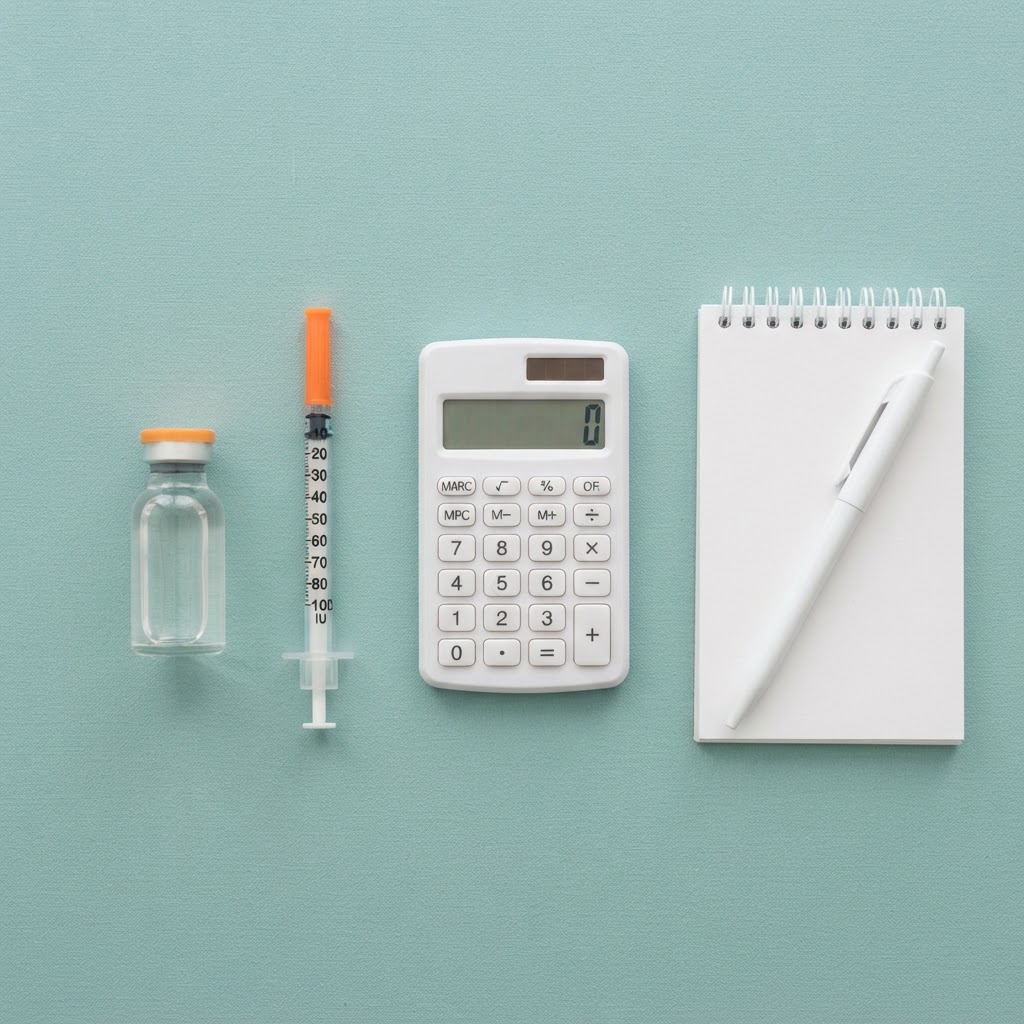
Understanding GLP-1 Dosing: How Injected Units Are Calculated
A clear breakdown of how GLP-1 medication doses are calculated from concentration and injection volume — covering mg vs. units, titration schedules, and practical examples for semaglutide and tirzepatide.
Understanding GLP-1 Dosing: How Injected Units Are Calculated
One of the most common sources of confusion for people starting compounded GLP-1 medications is the relationship between milligrams (mg), milliliters (mL), and units on an insulin syringe. This guide explains how these values relate to each other, how doses are calculated, and what you need to know to understand your prescription.
The Three Key Variables
Every injectable GLP-1 prescription involves three interrelated values:
| Variable | What It Measures | Example |
|---|---|---|
| Dose (mg) | The amount of active medication you receive | 0.25 mg semaglutide |
| Concentration (mg/mL) | How much medication is dissolved in each mL of liquid | 2.5 mg/mL |
| Injection Volume (mL or units) | The volume of liquid you draw into the syringe | 0.1 mL = 10 units |
The core formula that ties these together is:
Dose (mg) = Concentration (mg/mL) × Injection Volume (mL)
Or, rearranged to solve for the volume you need to inject:
Injection Volume (mL) = Dose (mg) ÷ Concentration (mg/mL)
Understanding "Units" on a Syringe
Compounded GLP-1 medications are typically injected using an insulin syringe, which is marked in "units." These units refer to volume — specifically, 100 units = 1 mL.
This means:
- 1 unit = 0.01 mL
- 10 units = 0.1 mL
- 50 units = 0.5 mL
- 100 units = 1.0 mL
The "unit" marking on the syringe has nothing to do with the strength of the medication — it is purely a volume measurement. The strength is determined by the concentration of the vial you are drawing from.
Important: The same number of "units" can deliver very different amounts of medication depending on the concentration of the vial. Always verify the concentration on your vial's label before drawing a dose.
Worked Example: Semaglutide
Example 1: Starting Dose of 0.25 mg
Suppose your prescription calls for a 0.25 mg dose of semaglutide, and your vial has a concentration of 2.5 mg/mL.
Step 1: Identify the dose → 0.25 mg
Step 2: Identify the concentration → 2.5 mg/mL
Step 3: Calculate the injection volume:
0.25 mg ÷ 2.5 mg/mL = 0.1 mL
Step 4: Convert to syringe units:
0.1 mL × 100 units/mL = 10 units
So you would draw 10 units (0.1 mL) from a 2.5 mg/mL vial to receive a 0.25 mg dose.
Example 2: Maintenance Dose of 1.0 mg
Now suppose your dose has been titrated up to 1.0 mg of semaglutide, from the same 2.5 mg/mL vial.
1.0 mg ÷ 2.5 mg/mL = 0.4 mL = 40 units
You would draw 40 units (0.4 mL) from the vial.
Example 3: Different Concentration, Same Dose
Now imagine you receive a new vial with a different concentration — 1 mg/mL — and you still need a 0.25 mg dose.
0.25 mg ÷ 1 mg/mL = 0.25 mL = 25 units
Even though the dose is the same (0.25 mg), the injection volume is 2.5× larger because the vial is less concentrated. This is why switching vials without recalculating can be dangerous.
Worked Example: Tirzepatide
Tirzepatide works the same way. The standard titration schedule is:
| Week | Target Dose (mg) |
|---|---|
| Weeks 1–4 | 2.5 mg |
| Weeks 5–8 | 5 mg |
| Weeks 9–12 | 7.5 mg |
| Weeks 13–16 | 10 mg |
| Weeks 17+ | 12.5 mg (max 15 mg) |
Calculating the Volume
If your compounded tirzepatide vial has a concentration of 5 mg/mL and you need a 2.5 mg starting dose:
2.5 mg ÷ 5 mg/mL = 0.5 mL = 50 units
And for the 5 mg maintenance dose:
5 mg ÷ 5 mg/mL = 1.0 mL = 100 units
At higher doses, you may need to inject from a more concentrated vial or split the dose into two injections, depending on what your provider prescribes.
Why Concentration Matters So Much
The key takeaway is that the same number of units on a syringe can deliver completely different amounts of medication depending on the vial's concentration.
| Vial Concentration | 10 units (0.1 mL) delivers | 50 units (0.5 mL) delivers |
|---|---|---|
| 1 mg/mL | 0.1 mg | 0.5 mg |
| 2.5 mg/mL | 0.25 mg | 1.25 mg |
| 5 mg/mL | 0.5 mg | 2.5 mg |
| 10 mg/mL | 1.0 mg | 5.0 mg |
This is why never assume the volume is the same when you receive a new vial — always read the label and recalculate.
Titration: Why Doses Increase Over Time
GLP-1 medications are typically started at a low dose and gradually increased. This process is called titration, and it serves two purposes:
-
Reducing side effects: Starting at a low dose allows your digestive system to adjust to the slowed gastric emptying that GLP-1s cause. Common early side effects include nausea, bloating, and reflux — these are often milder when the dose is increased gradually.
-
Building tolerance: Over time, your body adapts, and a higher dose is needed to maintain the same therapeutic effect (appetite suppression and blood sugar regulation).
Your healthcare provider determines your titration schedule based on your individual response, side effects, and clinical goals. Never increase your dose on your own — doing so significantly increases the risk of adverse effects.
Practical Safety Tips
- Always read the vial label before each injection. Confirm the medication name, concentration, and expiration date.
- Verify your dose in mg, not just units. Your prescription should state the dose in milligrams. Calculate the correct volume each time you use a new vial.
- Use the correct syringe. Compounded GLP-1s are injected subcutaneously (into fatty tissue) using a short, fine needle — typically 27–31 gauge, ½ inch or shorter. Insulin syringes are common and appropriate.
- Do not mix vials. If your concentration changes, finish or safely discard the old vial before starting the new one unless your provider instructs otherwise.
- Store properly. Most compounded GLP-1 vials require refrigeration. Check your pharmacy's specific storage instructions.
- When in doubt, ask. If your vial looks different, your calculated volume seems unusual, or you are unsure about anything, contact your prescribing provider or pharmacist before injecting.
Common Mistakes to Avoid
-
Confusing units with milligrams. A "unit" is a volume measurement on a syringe. A "milligram" is a weight of active medication. They are not interchangeable — the relationship depends entirely on the vial's concentration.
-
Using the same syringe marking when switching vials. If your new vial has a different concentration, the same syringe marking will deliver a different dose — sometimes dramatically different.
-
Increasing the dose too quickly. Titration schedules exist for a reason. Jumping ahead increases the risk of nausea, vomiting, and other gastrointestinal side effects.
-
Not confirming the concentration. Compounding pharmacies may change concentrations or send different strengths. Always verify before each injection.
Summary
Understanding how GLP-1 doses are calculated comes down to one simple relationship:
Dose (mg) = Concentration (mg/mL) × Volume (mL)
By knowing your prescribed dose in milligrams, checking the concentration on your vial, and calculating the correct injection volume in milliliters (or syringe units), you can confidently and safely administer your medication. When in doubt, always consult your healthcare provider or pharmacist — this guide is educational and is not a substitute for professional medical advice.
Medical Disclaimer
This content is for educational purposes only and is not medical advice. GLP-1 Primer does not recommend or endorse any specific medication, provider, or treatment. Always consult a licensed healthcare professional before making decisions about your health.

